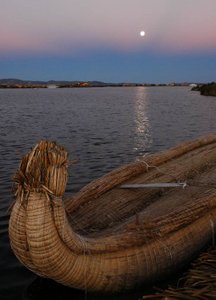
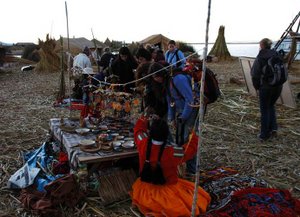
Quite mixed first impressions of Peru... After arriving in Puna, Peru, in the late afternoon, we immediately took off to do the "mandatory" boat trip to the floating reed islands. They should rather be called "floating souvenir shops", though. A most horrible experience! Total "into-your-face-tourism". Dreadful. It is actually a shame, since the islands are quite impressive, but the whole thing is really nothing more than a floating Disneyland. At least the islands you get to see during the standard tours.
The very pittoresque full moon over the lake helped soothing the totally artificial experience a little. But I was still very happy to get back to the hostel. But also Puno was not really intriguing - touting in Peru is so much more agressive than in Bolivia. I think I have been spoilt a bit. Could not wait to get away from Puno.
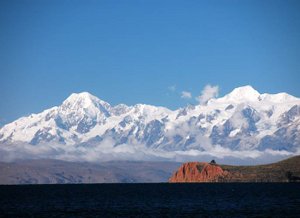
The Isla del Sol on Lake Titikaka is the birthplace of the first Inca, the sun, and the moon, according to the myths. A very tranquil island on which mass tourism has yet to arrive. As it has been electrified four years ago, the number of visitors, however, is steadily increasing. I happened to hook up with a very nice group of seven other travelers and we chartered a boat to the northern end of the island, where a complex of beautiful Inca ruins can be visited.
After the educational part, we went swimming in the crystal clear waters of Lake Titikaka on a gorgeous beach just below the ruins in exactly the place where the Incas must have enjoyed a little time off...
The three hour walk back along the islands hills was truly a visual treat. Great views into all directions across the lake! In hindsight I should have stayed more than just two nights.
Already the bus ride to Rurre(nabaque) along what the Bolivian tourist industry happily markets as "the worlds most dangerous road" (and which is hence very popular among us gringos to go mountain-biking downhill) is a true adventure! The road leads briefly up from La Paz to the pass La Cumbre at 4700m before then wiggling down towards Coroico at 1700m and further-on to Rurre at about 250m above sea level. The road is wedged into perpendicular rock walls, mainly only wide enough for one vehicle, very rocky. At one point it even leads straight through a few waterfalls.
I was slightly surprised when all of the numerous mobile vendors which entered the bus temporarily at La Cumbre were explicitly wishing us a safe journey and the benevolence of god... Also seing the woman in the seat in front of me sacrificing copious amounts of pure alcohol out of the window to Pacha Mama for a safe journey did not really make me feel more at ease.
Anyway, besides the danger title I thought that the road also deserved the title as the most bumpy and dusty road of the world - but I was wrong, these two titles most probably go to the track from Rurre to Santa Rosa in the pampas... I have never eaten so much dust inside a vehicle! And after the three hours this ride takes, I was very glad to get out of the car to ease the pain in my hurting bum.
So when I could finally leave the bus after the 18-hour ride to Rurre at 6 in the morning, I was quite glad to crash out for a few hours in a nice little hostel with hammocks and many tropical plants. Rurre is a great little place to laze around for a while and this is what I did for the day. It features a very pleasant tropical climate, a little market building where fresh fruit juices, empanadas, bread etc. are available for amazingly little money. The next morning I took off into the pampas, the flooded wetlands. To you folks at home: the Bolivian pampas pretty much resemble the Spreewald, except for the ubiquitous alligators and caymans, pink river dolphins, snakes, monkeys, turtles, piranhas, and the abundant bird-life.
So the first night after going up the Yakumo river in a motorized canoe made from a single tree, we set out to watch the light of our torches being reflected in the alligator eyes. Surprisingly many orange dots in the plants of the river banks... Some of the alligators were actually lying in the water only a few meters away from our camp. Further excursions by canoe from the relatively comfortable camp included a three-hour walk in gum boots through flooded marshland to find an Anaconda (without any success, only found an Anaconda skeleton), several swims with the peace- and playful pink river dolphins (one of them turning out to be "swimming with Anaconda", though), sunrise and sunset excursions, piranha fishing etc. Absolutely incredible wildlife!! Four days very well spent!
One of the highlights was actually when one guy of my group almost stepped onto a 2m long alligator being totally convinced it was made from plastic. Our guide had been joking about this before and the fact this impressive animal was lying motionlessly directly in front of an other camp on the river bank almost made this probable. The alligator only turned his head and made a hissing sound when the guy was about 20cm away, before slowly sliding into the water...
After one night in Rurre again, I set out into the jungle with the great bunch of people had met on the pampas tour. A four hour boat trip up the Beni river. In the jungle many more plants, hence much fewer animals to be seen. Much more humid climate, many more biting insects. Still very interesting, but certainly less impressive and pleasant than the pampas trip. We spent the first night in a camp in the jungle, leaving for a four hour walking tour leading well into the night, where we spotted a nocturnal monkey, came quite close to a tapir, a deer, and a group of wild pigs of several hundred animals(!). Often just waiting silently for the noises of the jungle, occasionally lightly brushed by some bats flying around.
The next day we set out a little deeper into the rain-forest to spend the night next to a little river on the ground just in our mosquito nets. On this trip we found a few fresh footprints of a jaguar (surprisingly big, I must say!) with a cub. Our very good guides explained a lot about the different uses of the enormous variety of the jungle plants during the walks. The next day back to the camp and to Rurre. In the end I was very glad to come back to Rurre and have a shower...
The flight back to La Paz was alright, only five hours of delay. I especially enjoyed the close-up views of Huayna Potosi and the whole Cordillera Royal before touching down at El Alto airport in La Paz.
You can photos of this great trip here. Have also added several pictures to older albums (Sorata, La Paz, Huayna Potosi)...
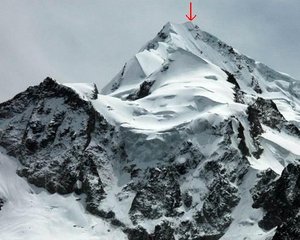
So I had thought I could just bag the odd 6000m summit.
Leaving La Paz the day before yesterday after a little odyssey getting half-way proper equipment from the agency (half the stuff was broken, they did not have plastic mountaineering boots my size, which we had to rent from an other agency in the end, etc.), we took off to the low camp at the Zongo pass at 4600m in a ramshackle mini bus. We that´s me and Trevor, my English companion on this trip, and Andrés, our Bolivian mountain guide.
After setting up camp, we went up into the glacier to familiarize us with the equipment and practice some ice-climbing which was good fun and a nice acclimatization exercise. It is surprisingly easy to walk up an almost vertical ice-wall with crampons and ice-axe!
Next day - yesterday - not much else to do than packing up camp and walking up to the high camp at 5130m, where the glacier starts. The weather was quite mixed and we waited out the snow and hail during the afternoon in the tent. I was truly fit, full of energy, and did not have any issues with the altitude. In the evening, the clouds ripped open and gave view onto the stunning mountain scenery.
Today, a very early start; we got up at midnight. And after an agonizing time putting on all the layers and the climbing harness in the extreme cold (I'd guess a good -20 degrees), we stood on our crampons on the glacier at 1am. Unfortunately I did not feel all to well, but attributed that to the awkward time to get up. A second guide had appeared the day before and so we took off stomping through the snow in two teams, me and Andrés, and Trevor and the other guide. It was a moonless night and there was hence absolutely nothing to be seen of the glacier or the landscape. Only myriads of stars above and the glitter of the snow crystals in front of my head-torch.
After a while and quite some climbing through snow and ice, the city lights of La Paz in the distance became visible. Occasionally the dark abyss of some giant crevasse showed up which would have easily swallowed a stack of five trucks or more. My boots were allright, only did I have very cold feet. I was still feeling weak. The thought of turning back crossed my mind repeatedly... Our guides were making us to walk relatively quickly, and I did have trouble keeping up the pace. But we were making very good progess. Below us, in the glacier, the flickering lights of a few other groups ascending became apparent. The first obstacle, a 40m high almost perpendicular wall of snow and ice, was still good fun to climb - jamming the ice-axe into the wall and just walking up with the crampons. The mittens I had gotten from the agency turned out be crap, not very warm and certainly not water-proof at all. So I kept walking on with numb hands and feet, having to catch my breath continuously due to the altitude.
Earlier than expected we arrived at the final 200m high ice-wall before the summit at 6088m. Here, a fierce wind made things even worse. The air temperature must have been at -25 degrees or below, the additional wind-chill was tremendous. At this stage I had already full-blown hypothermia and was quivering and shaking. No place to wait, or hide, or warm up.
Maybe this made me go berserk (literally!) - the strenuous climb up this wall seemed the only way for me to warm up somehow. So I had outbursts of quick climbs up for about five to ten meters, often catching up with my guide who was supposed to stay the full lenght of the rope ahead to secure me, and physical breakdowns on the ice-wall for a few minutes, having to catch my breath and gather energy. All that in pitch-black darkness. I was so desperately climbing, that we left the other team behind quite a way. I was amazed to watch the snot coming out of my nose as icicles straight... I was just hammering away with the ice-axe, not much caring for my numb feet and hands. Stopping on the wall was absolutely no option due to the cold.
When I finally arrived at the summit at about 5.45am after a far to long climb through the wall, my fingers and feet were frozen stiff and there still was no daylight yet. Nothing much to be seen, except the glittering sea of lights of La Paz in the distance. I was totally hypothermic and shaking bitterly. The altitude made things worse. No way even to think of taking out the camera. (You know me - this is a very bad sign!) I had the dubious honour of being the first person on the summit today, after my guide.
After only three minutes, Andrés and I started the descent. On the way down, I tried to warm up my completely numbed fingers. And all the way down to camp the only thing I could ever think of was my warm sleeping bag. After the sun had come out, the outlandishly beautiful glacier landscape and the rim of gorgeous peaks around became visible. Unfortunately, I did not have the slightest amount of energy left to appreciate the stark beauty or to take pictures.
Yes, no need to argue, I should have been more sensible and should have turned back earlier. I did have a bad day and should have realized. This trip was certainly one of the most extreme situations I have been putting myself into ever. But by now, being back in La Paz, most of the feeling has returned into my fingers and toes. And after eating, drinking and sleeping a little, I feel almost human again.
But do not get me wrong - I did enjoy the trip lots, despite the suffering!
The bus journey to Sorata already is an adventure. A good five to six hours from La Paz for about 136 km! And the first half of the road up to Achacachi even has asphalt... After that a dirt road starts, leaving the Altiplano and descending into the valleys. Most of the track consists of potholes, rocks, river crossings etc. You certainly would not like to take your car down here. And you would not get very far... Incredible the old japanese buses make it! Keep in mind that this is a "major road" in Bolivia! So when I finally arrived in Sorata, my bum was properly hurting from the bus journey.
The next morning I set out into the mountains to the Laguna Chillata (4204 m) - a steep 1500 m ascent! I was pretty much puffing after the first 800 m due to the thin air. This is where I met Dan, a nice English guy going the same route. So we went on together for a while, but soon I had to stay behind. The last few hundred meters in altitude I felt really bad, had to sit down after every 50 m distance. When I finally arrived at the Laguna Chillata, Dan had already been there for an hour. I was slightly sick, threw up once. I think now this all had to do more with a strange mandarine I had eaten for lunch. I tried to eat a carrot for dinner. After about one hour there was still half a carrot left... I really could not eat anything! So I decided to turn in. The sun was going down and it became really chilly anyway. After dozing for about an hour I woke up again, feeling really hungry! So I ate the rest of the carrot, some biscuits, and chocolate. I even managed to peel myself out of the sleeping bag and get more water from the lake. And at that time it was freezing cold outside!!
After a good night sleep - about 11 hours - I felt really fit again! So I decided to pack in everything and continue up to the Laguna Glaciar together with Dan. We were told the path would be much more difficult and the camp site up there at the lake "muy frio!". The latter was certainly true! The trail was actually not so bad, just a long, long slog up across moraine boulders and scree. The altitude made things very exhausting. But at least I did not have to sit down anymore. So when we finally arrived at the lake, we both were really glad we could stop. Gorgeous scenery! A huge glacier breaking off into the lake, ice-capped mountains to both sides...
Due to the lack of oxygen, everything took at least twice as much time as normal. Even the brain seems to work at slow motion. But time we had. After setting up our tents, we were cooking lunch, which blended into an early dinner. And shortly before sunset, the clouds opened up and we were rewarded with a fantastic sky ablaze with orange and read. The views across the valleys and even Lake Titicaca in the distance were spectacular.
After sunset it immediately became so extremely cold that we had to hurry into our respective tents and sleeping bags. This night I only slept on and off - thin air and low temperatures. My water bottle was half filled with ice in the morning giving a nice tingling and rattling sound. Breakfast in the cold, i.e. the shadow of Illampu. The sun only reaches the camp site at about 8.30 am. So lots of time to wait around and take pictures of the the sun brushing the hills in the distance (with stiff-frozen fingers).
Than a relatively easy walk back to Laguna Chillata, where I spent the night again. Dan went on all the way back to Sorata. I just did not want to rush down 2300 m in one go. So the last day was really relaxed as well. The weather was ideal; blue skies, no wind. After breakfast, I had plenty of time and could even do some Tai Chi - at 4200 m, overlooking the deep valleys and the mountains in the distance. What a treat! The 1500 m down from the Laguna Chillata, which had cost me about 6 hours during the ascent, only took a good two hours down in perfect weather. Walking down I realized how steep the trail actually was!
Arriving in the early afternoon, I could watch the whole town of Sorrata indulging in what appeared to be at least three simultaneous weddings. Lots of dancing in the streets... And so many drunken people, including a brass band of at least fourty guys!
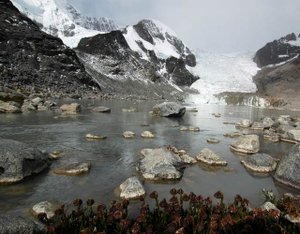 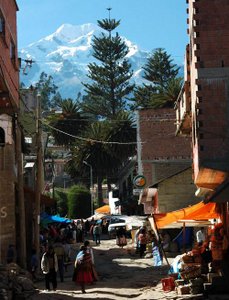
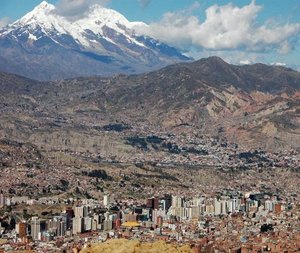
What to say? I am pretty much torn between: horrible! All that noise, dirt, smog, traffic etc. - and: fascinating! So many people, small alleyways, snow-clad 6000m mountains on the horizon... Half the city appears to be a street market. And there is almost all on sale, there even is the official witch craft section. Amulets, herbs, dried animals of all kinds - especially popular llama babies, apparently. But also quite nice cafes and restaurants, all slightly more expensive, but still dirt cheap. Met many former travel companions again. Good place for socializing.
Have to keep this short as I am already in Sorata. Managed to get the one (!) computer in town for a few minutes and as the power situation is stable at the moment, the internet even works! Had to wait all afternoon for this to happen. Few other tourists... Have bought supplies and will be off into the spectacular mountains for three or four days.
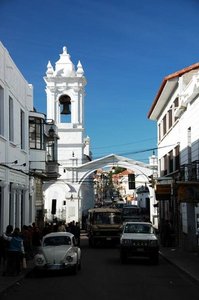
Almost European again. Sucre has a distinctly civilized touch to it. Beautiful colonial architecture, nice pizza restaurants, a Dutch pub (the foreigner meeting place). But the "other" (i.e. Bolivian) side as well. The huge Central Market brims with activity, all sorts of bread, fruit, veg, meat, household goods... A section of at least 20 stalls selling freshly made fruit juices (my point of reference in the market), and the whole first floor cheap and tasty eateries, middle-aged women surrounded by many pots and pans with all sorts of basic but tempting food. And people. Very many people. And many beggars and people living in the street. Begging is actually quite intense and into your face. Takes some getting used to.
I keep meeting dozens of people I have met before in Tupiza, Uyuni, and Potosí. So this is the gringo trail between Ecuador and Boliva, I guess. But nice, no lack of company. All in all a very pleasant place to hang out for a while.
Will add a few pics later on (no time anymore, have to catch my bus to La Paz in an hour).
Potosí - once a synonym for wealth. Today still an important mining town. The main hill - Cerro Rico - contains an enormous variety of minerals. Potosí is the highest city in the world with more than 100.000 inhabitants and an altitude of 4000m.
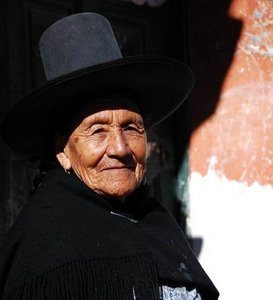
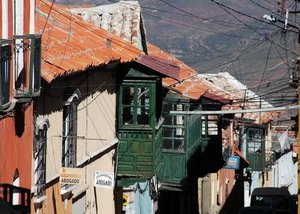
Walking around in the city is a great pleasure, many older and a few colonial building remain. And I found many interesting little corners in town which indeed required a little time to discover. Again I enjoyed the fact I could speak to the people, e.g. the conversation with the friendly old lady I met in a tiny little market square (see the picture below). Most travelers only come to Potosí to take a tour to the silver mines in Cerro Rico, but I think the city has a lot more to offer!
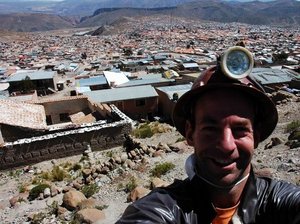
I did the tour as well - yesterday. The tour to the mines is an experience. It's really intense. The working conditions are rough, to say the least. "Medieval" would apply, too. We first got a complete set of clothing; jacket, over-trousers, gum boots, helmet with lamp and battery. It was recommended we did not take anything besides our camera - the mines would partly be very narrow (and they were!). Then we went to the miners market where our guide demonstrated the proper use of coca leaves and catalysts, the different varieties of dynamite available (Bolivian - cheap and good quality = bang for the buck, the paste can be formed to need; Peruvian - cheaper but bad quality; Argentinian - more expensive, very good quality, unfortunately not anymore available on the Bolivian market), nitrate to enhance the explosion, how to put the fuse into a roll of dynamite. We were then introduced to the miners favorite drink - pure alcohol of 96 degrees. Not too bad, actually. We bought some of these items as presents for the miners later on. A complete set of dynamite including a bag of nitrate and a fuse is available for as little as 2€ - freely available for everyone, even for kids. Also frequently used as firecrackers in the streets. A little unsettling.
Then we visited a plant where the mineral is being grated and the metal extracted. It looked more like a chemical plant of the 19th century. No security for the workers whatsoever. But still a lot better working conditions than the actual mines!
Then the mines, which we visited during normal operation. Our guides assured us they would know where currently dynamite was being used and where the carbon monoxide levels were too high. I am lacking the words to properly describe what I have seen. Pictures of the tour continued flashing back in my mind and kept me awake all night. Very strong experience! We first had to wait until the mineros who push the carts had passed. No one would stop in the mines for a few tourists... The entrance tunnel already appeared to me very narrow, already here almost no spot to stand upright (for me at least). We were told not to touch any of the cables and tubes that were dangling everywhere. No order to be recognized.
After a stop in a little cave used as "museum" with a few items and explanations on the mines we went further on into the first level. Now things became really narrow and low. Occasionally crawling on hands and legs we had to fight our way through the incredible fine dust. We were now at least 200m inside the mountain and the temperature had risen to about 30 degrees. Breathing was very hard, not only due to the 4300m meters of altitude! Our guide made us climb upwards through a hole in the rock which appeared incredibly small. Well, I guess being tall is quite a bad thing under such conditions. There were some odd wooden structures to secure rocks and prevent rubble and sand from falling further down. We arrived at a tiny little cave with a wooden construction and an electric winch with which one of the workers would pull out huge leather bags with minerals from a 50m deep hole. There was barely enough room for the eight people in our group plus our guide huddled up on the rock walls and the worker. The ground we had just crossed turned out to be a hole in the floor through which the minerals were passed into some carts further below. Absolutely no security standard whatsoever. We left a bottle of fizzy drink and coca leaves with the poor soul and kept climbing and sliding through more narrow holes in the rock until we reached a part where a strong basic solution was left to seep through the soil as a method of filtration. Nowhere space even to properly sit upright. Then sliding and crawling down again through a very dusty tube into the main tunnel where we visited three guys working on other prehistoric machinery. More gifts were handed over here, and the workers started chewing their coca leaves. They work for at least 10 hours under ground - without food. The coca prevents them from noticing hunger and thirst... Some would stay 16 and even up to 36 hours in the mine without sleep if they would not encounter minerals. They all work basically freelance, most in cooperatives of a couple up to about fifty people.
Although here the air was still "relatively" good but dusty, I decided I had seen enough after about three quarters of an hour. I felt I would be better off leaving as long as I felt still well, and so I asked one of the guides to walk me out. The relatively straightforward walk/crawl back to daylight took about an other 15 minutes. And I did enjoy every minute in fresh air of the about two more hours I had to wait for the rest of the group returning. Apparently I had left at a good spot, just before they would go down to levels 2, 3, and 4 where, according to the others, things turned even more nasty. Creeping down and up through very low passages with heaps of dust, having to climb down shaky wooden ladders with many damaged and missing steps, really bad air and so on. When the others finally stumbled out of the tunnel, everyone was very glad to be back out again and truly exhausted. And everybody was thickly covered in dust and dirt.
No surprise about 40 people die annually in these mines. The estimate is that about 8 million (no typo!) people have died in total in the mines during the last 500 years. The Spaniards often would not even let the indian slaves out of the mine at all.
As a sort of final entertainment we were made to blow up a few sticks of dynamite. I was shown how to push the fuse into the dynamite paste and before I knew any better I had a stick of dynamite in my hand with a burning fuse! No joke! Some of the others had the same experience simultaneously... So there we were, looking bewildered at the dynamite in our hands. I tried to keep calm and attempted to extract an explanation out of our guides on what to do next. In place of an answer the guides would just snatch the dynamite sticks out of our hands and run a little into the hill where they let them detonate just somewhere. Totally crazy!
Hard to believe people actually work under these conditions. Hazards and chaos everywhere.
More photos here.
Four days and three nights in the Bolivian highlands - what a great journey! Certainly one of the most amazing trips I have ever done. Six of us tourists in a jeep, plus a driver/guide and a cook. Not overly much space, but enough. All the luggage (and the kitchen and spare fuel) on the roof of the jeep.
Starting from Tupiza up through a gorgeous valley, getting visually quite close to Bryce Canyon. Then further through the hills of the Altiplano, passing a few very remote villages completely built of adobe. Obviously not (yet) so much traveled by tourist, the villagers apparently did find our presence interesting and/or disturbing, sometimes. Many Llamas and Vicuñas (the Llamas slightly smaller siblings), beautiful hills. This is the supposedly "boring" day of the journey - I was already very much impressed. The first night in San Antonio de Lípez, at 4200m altitude, was a little difficult for all of us. Who did not suffer from nausea did at least have a headache and trouble catching his/her breath... I had the impression I did not sleep at all that night. We were impressed the "hostel" had electric light! The general standard is very low. Our cook impressed us - after an already very nice lunch - with a great dinner. Basic but tasty.
Second day - getting up at 5 am, well before sunrise. Breakfast did not really go down so well. Gorgeous night sky with innumerable stars out. Very cold morning. Had to push the jeep into operation - the spark-plugs were frozen in. Once on the jeep, watching sunrise over the hills and mountains was truly great. Stop at Fantasma, a mining town of the Spanish, which once housed more than 500 Spaniards and 1000 Indian slaves. Folklore has it the devil himself lived here for three years. But this is a different story I might tell an other time. After Fantasma, we climbed further up toward a beautiful pass, lightly covered in snow and making for some more gorgeous views. We came across two trucks blocking the road as they had broken down the night before. Not a nice spot to spend the night. Our guide changed a wheel of our jeep at the Laguna Morejon, from now on he would spend every minute not driving under the car. Incredible views - lagoons, flamingos, snow-capped mountains. Passing Laguna Kollpa and Laguna Blanca toward Laguna Verde. No flamingos here - no surprise, the green color is due to the high Arsenic content of the water... Then a nice hot bath in a thermal spring - at 4800m! More mountains and flamingos in the background. Even more - and totally different desert landscapes.... Then the Geisers Sol de Mañana at 5000m, no fences or security whatsoever - you just walk around, but a great sight! Very long day, 12 hours, mainly in the jeep! But the scenery makes you forget that.
Third day - getting up at 7am, quite relaxed start. Three hours at the Laguna Colorada since our driver removes the fuel from the slightly leaky tank, completeyly disassembles the tank, fixes it with help of a custom made piece (from his leather belt!), and assembles it again. He totally knows what he is doing... We have a slight leak in the oil system, too. Our driver is a little tense, starts chewing coca leaves. But the views on Laguna Colorada - totally stunning! Heaps of flamingos. Further through the highlands, lunch stop at the Arbol de Piedra, slightly extended as our driver keeps fixing parts of the jeep before they break down. Unfortunately one of our group feels nauseous again. The problem with the oil and the upset stomach make us detour toward slightly more civilized settlements.
Fourthy day - getting up at 7am again. First to Uyuni to sort out accomodation and find a resting place for the sick stomach. Then further on to the Salt Lake (the biggest and highest in the world, at 4000m). Unreal sight! Visiting the Salt Hotel - completely built from salt bricks. Nice. After lunch back to Uyuni. The town is not as bad as described in the travel guides...
We were very lucky with our jeep and driver - besides some little hick-ups, nothing serious. Other groups broke down in the middle of nowhere (there is a lot!), had to spend the night somewhere, wait for an replacement jeep for a day or so, or ran out of fuel and/or food and so on.
More pictures here!
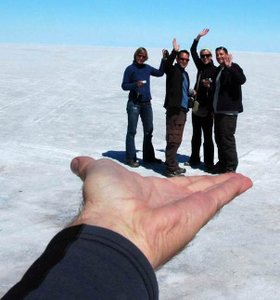 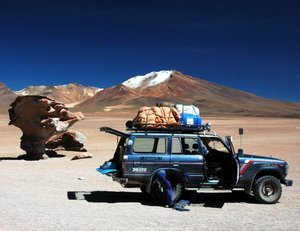 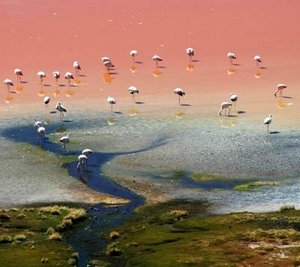
Bolivia - now really a different world! After crossing the border at La Quiaca in only about 3 minutes (my fastest border crossing in South America so far!), I had to wait for the bus. My first impressions: everything much more chaotic, colorful, and slow. Everything is slow here, really slow! The bus starts loading about an hour before departure (you have to be there at least half an hour early), since the whole procedure takes ages. Then there are about 20 people in the aisle, standing for the whole ride. The bus ride for about 80km took a good four hours, including the change of one of the front wheels as it had a puncture. This is actually no surprise given the quality of the dirt roads.
The drive to Tupiza leads through stunning landscapes. Serrated rocks in all shades of red, different species of giant cacti, beautiful hills on the altiplano. Tupiza turns out to be a pleasant small town, today is the market day and many people from the surrounding villages come into town to buy and sell stock. Many beautiful old women in brightly colored skirts, boulder hats and the typical carrying cloth containing the vegetables, herbs, and the odd baby. Unfortunately they are not very fond of the relatively numerous gringos (well, you know every other foreigner in town within about two hours, but still, they seem to receive more than enough tourists hereabouts), and having their picture taken is something they obviously do not like at all.
Tried to chat a little with one of the old women selling all sorts of magical remedies including at least a hundred different herbs and dried parts of plants, mummified llama fetuses (apparently very popular with easter), armadillos, birds, toucan beaks and so on. She really would not like me to take any photographs. What a shame. Sat around on the street to watch people and street life, this already being totally fascinating! Just had the best pizza so far in South America - with goat cheese and sweet corn, yum! (Disculpen amigos argentinos, pero és así!)
I am very glad I have learned some Spanish in Buenos Aires! This was already a delight in Argentina, of course, but here it just allows for a completely different experience. Sorting out the necessary stuff for traveling (at times a little odd and inefficient in Bolivia!) is now a real pleasure. Being able to talk to the locals transforms the experience totally! Well, there are quite a few people who actually do not speak Spanish. But still.
So far, Bolivia is a tremendously positive surprise! The people are very friendly (at least the ones who are not so reserved), found very nice travel companions, accomodation turns out to be almost luxurious (I am sharing a double room with TV and private bath room with a nice Canadian girl I met on the bus), food is good, all fine! But slow. Had to wait about an hour for my pizza, one other customer in the restaurant... The internet is extremely sluggish, almost slower than the net in Tilcara during the rain. So no way I can upload any pictures from here. Maybe from Sucre or La Paz.
Tomorrow I will be taking off for the four day jeep tour through the altiplano to see the lagoons, volcanoes, and the salt lake of Uyuni. So it might be a little while until you hear from me again.
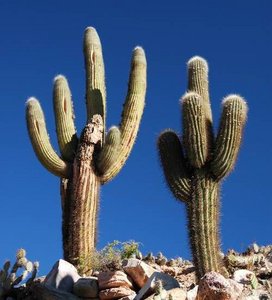
An other world.Tilcara in the Quebrada de Huamahuaca surrounded by beautifully colored hills in all shades of red and yellow, barren landscapes which turn out to be densely covered with surprisingly many different species of cactus and other plants that can withstand the climate. Some of the cacti are enormously big - up to 9m!
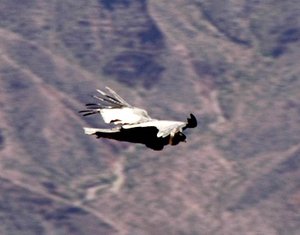
Found a quiet hostel with beautiful shared bungalows with deck chairs and hammocks under big trees on the slope of the hills, an ideal place to spend a few days. Went to see the Gargantua del Diablo, continued to walk along a dried out river bed, and finally a little hill well above the village. Stunning views! And even a Condor flying relatively close by...
Will stay a few more days to enjoy this pleasantly chilled place where the lady from the sandwich shop has to go next door to get some change for the 10 Pesos I gave her to pay my bill of 3 Pesos. And where you can have a chat with the guy working in the "supermarket" who is also waiting for it to open - at half past four... (supposedly open from four o'clock).
Quick update, not much time right now... Time flies! Now I am finally continuing my journey up north. Life in Buenos Aires had turned into a true and pleasant normality, which I realized saying good-bye... Already looking forward to coming back in a few months from now!
Took the night-bus (20h) from Buenos Aires, very comfy. Lots of food and drinks on the bus, very nice leather seats... Jujuy - rather grey (due to the clouds) and very crowded! A nice little place to get my travel plans sorted, the last real city before the Puna and the Bolivian Altiplano! I am not quite sure if I will be able to access the net in the days to come, so maybe you will just hear from me when I arrive in La Paz?! We´ll see. That´ll be all for now. Take care everybody!

Done. Finally. Uff. After two very intense weeks in front of the computer for at least 14 hours a day, I have just now released the first version of my stock photography website! As I do not expect to become rich (or even earn money at all, really!) this is more an experiment and it certainly has been a very welcome brain exercises for me. Given that I did not have any knowledge whatsoever of how to set up a website and / or a picture database, I think two weeks are actually not too bad. And no, it is not just a template I use. (Wish it was!) Certainly the work is based on templates, but so severely modified and extended that it actually does not have to do much with the starting point.
Many desired features are still missing. To start with: galleries, more pictures and an automatic ordering facility. But I feel these are not major issues, since I have a few possible solutions in mind. Most of that, however, will have to wait for a few months until I reach decent and accessible computer infrastructure again.
Of course, the site is currently still rather plain and does exhibit a few quirks. Watch it preferably with Firefox, Internet-Explorer does not like some details. And yes, I know, the logo sucks. But the whole thing works. Let me know if you should spot any problem, feedback welcome! (Oh dear, just spotted a really weird issue. Let's see if anyone finds it.)
If I had actually known how much effort this would cost me, I would probably not have started the whole business. But now it's done, I feel truly relieved. I can finally start to live again. There was not much "life" during the last two weeks, but I should not complain. My own choice, really. Poor Veronica, she had to put up with this computer-zombie in her living room for two weeks... This page would certainly not have been possible without her kindly letting me occupy her computer full-time for this period!
So time to leave and get on the road again. And time to take more pics! Will let you know about my trip as soon as there is anything to report. Hello world, here I am back again! Time to re-start my journey.
P.S.: Right, I almost forgot - you might want to have a look: www.ck-images.com
Thought I had disappeared?! No, wrong! Still life and kicking. Almost a month since I have been writing last, though. But since, for the first time in a while, my life has been a little bit more regular again, there was not much to report. Most of my time has been occupied with Spanish lessons, homework etc., anyway.
Besides that, only a few small discoveries - as, e.g., tomato jam. Yes, you read that correctly! I became quite a fan of this stuff, almost all my breakfast toasts now are covered with this fabulous spread. And then there are the "licuados" - banana or strawberry (or what ever is available) milk shakes. Yum! And then I finally managed to get a shot of this traffic light in Palermo with the marijuana leaf shape in the green light. What's the message?!
What else to speak about? Well, the weather. After a few weeks with maddening heat, the early autumn now makes life a true joy. Crisp air and a slight breeze render the heat during the day very bearable. And it almost never gets any hotter than about 28 degrees anymore. It does feel slightly fresh, however, when the temperature drops to about 20 degrees at night. But certainly nothing to complain about! ;-) I understand that most of you, being up there in Europe, had plenty of fun with snow and ice this winter.
An other reasons for my silence is that I have been very busy the last weeks to learn about advanced digital photo processing (awfully time-consuming!) and website-building (a science in its own right, as far as I can tell). I see it as an 'interesting project' for the moment, rather than a possible source of income, though. In the nearer future, I hope, I can put up a website with a few stock images for sale. Let's see! All this is, at least, something new to learn and some brain exercise for me.
I keep postponing my departure to the north. Life is just so pleasant in Buenos Aires at the moment. But this inertia is not going to take long anymore. My current plan (might change - that is the beauty of long-term traveling) is to get going again around mid of March. This time up to Bolivia, Peru, and Ecuador. Provided I am not changing my plans...
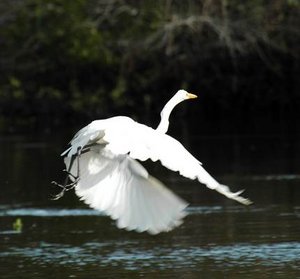
Also I have been pretty lazy with my camera - even leaving the good thing at home most of the time! So I can only present you these two snapshots. One of a the bird-life present in the neighborhood and one of the traffic light in Palermo.
 
Since Friday last week I am back to Buenos Aires and enjoy city life and a social environment. I am staying with a friend of a friend of mine who happenes to have a room to let. This accomodation turns out to be the greatest luxury in all my traveling so far! Not only do I have my own room with wardrobe, bookshelf, and a little table, but also my own bathroom! And, even better, a grand roof terrace right next to my room!
But all this is topped by the joy of sharing the house with Veronica who is truly amiable and very patiently puts up with my shaky Spanish. This brings me to the subject of language classes which I started taking again last Monday. What a pleasure! But very exhausting, too. Besides school - four hours a day - and homework, I did not do that much during the week, except maybe the odd conversation with Veronica. Being an actor and singer, she invited me to a gig she gave last Sunday in a bar in Palermo, which was truly great. She has an impressive voice and sings a repertoire of Latin-American folk songs.
Even more impressive was the gathering in our house last night. Veronica had invited a group of friends for dinner, many of them musicians and singers themselves. What a special bunch of people! We ate and chatted on the terrace and then someone brought out the guitar and some percussion instruments around midnight... Without even a single repetition and without a break we kept singing Latin-American songs until way past five in the morning!!! Well, I should really not include myself here - as some of you may know, I am musically rather challenged. But I did help out a little with the percussion. All sorts of genres were brushed; sambas, boleros, well-known Argentinan songs, as well as songs from all over South and Central America, even compositions of some of the people present, and - of course - many Tangos. I felt quite embarrassed for not even knowing a single German song. Unfortunately we do no have a culture of meeting up with friends and spending whole nights singing. Before five nobody left. And after many people had gone around then, we kept chatting with the few remaining souls. I hit my pillow a little before eight in the morning, the time I normally get up and ready for school. What a night! Certainly a highlight of all my time so far in South America.
When I arrived in Iguacu - after 28 hours on the bus(es) - mainly one thing I noticed; heat! The last hours on the bus going through perfect rain forest, tropical flowers everywhere, palm trees, bananas bushes growing as street trees in the villages... Plenty of bird life. After lugging my backpack to the hostel a few blocks away from the bus terminal, and after a first shower, back to the terminal and straight into the bus to the national park Iguacu in Argentina. Arrival at about lunch time. The little gas train takes me to the different walks in the park. Impressive views, colorful (and huge!) butterflies, parrots and other birds. Get to see my first toucan in the real world. At the visitors center a few leaflets on the park; one of them explaining in detail what to do (and what not) when encountering a puma. Very reassuring! The falls are truly impressive! I do what I have to do and take too many pictures. After about five hours walking around the falls I am very close to heat stroke, though. Only copious amounts of water which I have to buy in half-liter bottles for ridiculously expensive 4 pesos each (about 1,20 €) seem to save me. I sweat like hell... Most people walk around without shirts, girls in bikini tops. Back to town. I book my return bus ticket to Buenos Aires straight away for the next day in the afternoon. To much heat. This, and there is not so much more to do besides the falls. I decide to skip the Brazilian part of the falls. Falls are falls, I think. I do change my mind spontaneously after a good nights sleep and get going to Brazil early next morning. Officially I am leaving Argentina, but the Brazilians can not be bothered with the day tourist and deny me an entry stamp. The Brazilian side of the park has great panoramic views of the Argentinian side. I am glad I went! Get to see more wildlife, a Iguana feeding on berries next to the walk, more birds, more butterflies. After a couple of hours in the heat again, the journey back to Argentina. Again close to heat-stroke. I save myself in a cafe with air conditioning. But the heat must have impeded my thinking. I am leaving late with only ten minutes to go until the bus leaves. I end up having to run for the bus terminal. Uphill. I reach the terminal just in time, but totally drenched in sweat. Just enough time to change my T-shirt before I get on the bus. At the moment I plummet into the comfortable seat, my fresh T-shirt is already drenched again. Thank god for the air conditioned buses, I think. Yes. As it turns out, the air-con is not quite up to the heat and gradually breaks down after half an hour or so. Sauna on the bus... Of course it is a modern bus of the type without any windows to open - it has a brilliant air-conditioning, nobody needs windows! Some passengers bitterly complain with the drivers. So after a couple of prolonged stops to let us passengers cool down in the 35+ degrees outside (it is evening already), the bus company decides to send a replacement bus. We talk about hyper-modern double-decker buses with better-than-business-class-seats! We meet the new bus somewhat later on the road, while the air-con seems to have miraculously recovered. Or is it just the absence of the sun?! Anyway, we change the bus, our luggage remains on the first bus. As it turns out the new busses air-con is even weaker... Again sauna. Interesting conversations with my fellow passengers - nobody understands what is going on. So a couple of hours later, we change back into our first bus which has been following all the time, and hope the air-con is not breaking down again. Which, thank god, it did not do until we arrived in Buenos Aires. 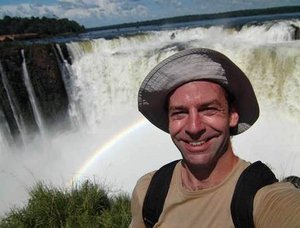 
After a 12 hours long and visually quite spectacular bus journey across the Paso Jama (4200m), I have now come back to Argentina. From the bus I got to see many snow-clad volcanoes and some peaks above 6000m, salt lakes, spectacular canyons, lamas, flamingos, and giant cactus trees up to 6m high!
The bus trip would have been a perfect treat, if I had not been surrounded by this family of six (three boys of about 3 to 7 years, a baby and the parents), who all took turns in throwing up during the journey. Yes, all of them! Other than this, they were quite lovely, but not worrying much about cleaning up the mess they left on the floor and also leaving their "used" plastic bags in the bus for someone else to remove... The highlight was when father and one of the sons where puking together into the same bag - a real duet, so to speak. Besides the slightly repugnant smell and the distracting noises, I truly enjoyed the ride.
Salta turned out to be - hot! Arriving arround midnight the temperature had barely dropped to 30 degrees. Not to speak of the humidity. But the city itself has a very pleasant atmosphere and the colonial architecture contributes a lot to that. Unfortunately I could only spend a day here, otherwise I would have had no opportunity to travel to Iguacu directly. So sorry folks, no city pictures.
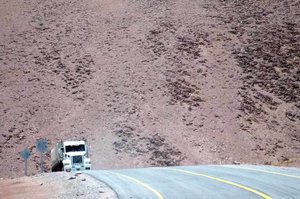 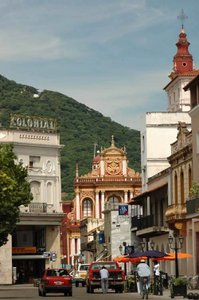
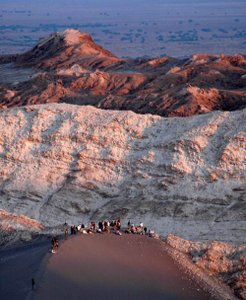 A town in the earth driest desert. And guess what? It rained! Well, sort of. A few drops. But still. This is what they call "Bolivian Winter"; clouds and some rainfall. But other than this - yes, it is dry, you need to drink a lot during the day and the altitude (a respectable 2400m above sea level) lets you a little breathless at moments the first day or two.
Otherwise the town is just an other tourist rip-off with a relatively laid-back atmosphere. Nothing seems to move before 11am and shortly after that, the siesta closes almost everything down until about 5pm. So I did "the tour" into the nearby Valle de la Luna (see also the other photos). Really spectacular!
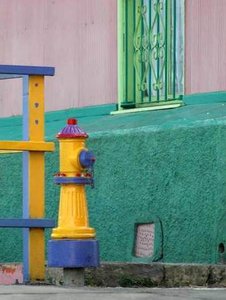
Three days Santiago. Seems enough for me. It's a big city, yet an other one... Not bad, though. A bit smoggy at times, but mostly alright. Nothing wrong. Nice people. Liked it more at night, as my photographs may reflect. Nice museums - especially liked the one on pre-columbian cultures in South America (very good exhibits!).
Had a funny conversation with a nice Bolivian doctor last night in the restaurant who had come to Santiago for a Herbalife convention. Asked him what Herbalife was. Seems that I actually missed in the past that I urgently need the 84 special ingredients for my nutrition which only the Herbalife products contain! How I managed to get as old as I am is a miracle... The funniest part was when he explained to me how I could earn up to a million dollars and more a month by joining the "family"! Yet an other pyramid game. And fairly successful as far as I can tell from the number of "members" he mentioned (was it 900.000 worldwide?). In the restaurant were many other Herbalifters - from Chile, Colombia, Venezuela. Obviously making enough money from their distributions for long journeys to such "extravaganzas" as the convention was called. Very nice chap, the Bolivian doctor, but very fanatic, too. Dollar signs in his eyes... At least a free Spanish lesson for me.
Have been pondering an Aconcagua attempt for several days. Finally decided against it. Too much gear I would have to organize (rent or buy). Not a difficult climb in itself, but very cold - hence the equipment necessary (mountain tent, very warm sleeping bag - going to -30 degrees, plastic climbing boots, mittens, crampons, ice axe, and a lot more...). Too much effort. And then the altitude (i.e. time required to aclimatize...). But I am still tempted. Anyone possibly interested in changing my mind and teaming up?! Or any other (not too technical) mountain?
So today Valparaiso. First impression - OK. Yes, it is a nice city on funny hills. Yes, its architecture is slightly chaotic and relatively old, odd, and colorful. And a port. Impressed? Not so much. Nothing wrong, though. Good place to hang out for a while, I guess. At least smaller than Santiago, but still quite big. Staying with lovely Signora Maria, a tiny but very cozy room near the center. Good to have my own room for a while!
After a couple of days in Pucón, Chile, I am going to Santiago on an overnight bus later on today.
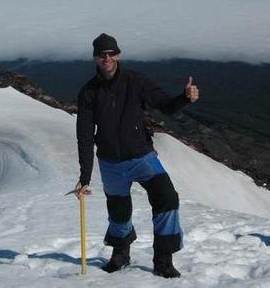
The night before yesterday was a little short as we had to get up at 3.30am in order to get an early start with our guide Claudio, who also happens to be the owner of the hostel some of us were staying at. It had taken me quite a while to get used to the idea of a tour, but you are simply not allowed to climb volcano Villarica on you own... Those of you knowing me better will be aware that I am actually heavily allergic to "guided tours" and "tourist excursions" organized by agencies. The good side to the organized tour, however, was that we got all the necessary equipment (including ice axe, crampons, gloves, helmet, gaiters, over-trousers, jacket, backpack, even mountaineering boots if needed), so I did not have to rent any of these things. And the transport was sorted out, too, of course.
So we got onto the minibus at 4am, reaching the ski center on the slopes of Villarica at about 5am, from where we started walking. In the next hour I almost fell asleep again, trudging through volcanic scree and rubble. To our surprise it was almost warm at about 1900m! Given the time of day (read night) almost a miracle. Almost now wind made for ideal condictions. Soon, we would start walking on snow, first without, later with the crampons. The pre-sunrise light and later the early morning light created marvelous vistas of the partly cloud covered landscape far below. With only a few short breaks, we reached the crater rim at 2847m after only four hours ascending. A really easy stroll, as far as I am concerned.
The sulfurous fumes from the crater made breathing quite difficult at times, but the view of the splashing lava was certainly compensating for that. Also the vistas of the surrounding volcanic and non-volcanic peaks are spectacular. The walk down across the glacier and snow fields was sped up by long and fast slides in snow tunnels. Very good fun indeed! When we descended we came across about two hundred(!!!) people plodding through the snow. All from the regular groups departing at about 8am from Pucón. Volcano mass tourism. At this stage I was really glad to be on the "early bird" tour, also avoiding the burning sun for the longest part of the walk.
| |


